Learning to Show, Not Tell
Why I'm rewriting The Many Truths of Josef Batten.
The Many Truths of Josef Batten was first published in August 2025.
I never intended to become a novelist, I consider myself more a visual artist, but getting this story out has mattered to me.
This was my first novel. I don't yet know if I will write another. Understandably, most first novels don't succeed, and I'm fine with that. However, there are many reasons why I think this story deserves a second chance and to be as powerful as I can make it.
What was wrong with the first edition?
Numerous early readers generously let me know that in the first edition I was telling rather than showing, and they were right. As a war photographer, Josef's emotional landscape was something they, the reader, should have been given the chance to surface for themselves, rather than be told about.
What is changing in the rewrite?
I'm undertaking a rewrite, this time with an editor on board who is patiently offering me the guidance and experience I need. As a result, the revised edition is becoming leaner and a more comfortable read. It shows more and tells less and trusts the reader to sit with uncertainty and, I hope, to come out the other side having understood something they couldn't have been told.
I've unpublished the original edition while I finish this work. If you were an early reader, thank you.
I intend for the revised novel to become available again later this year. What follows is a draft of the preface for the entirely refreshed edition of The Many Truths of Josef Batten. It describes why this story matters so much to me.
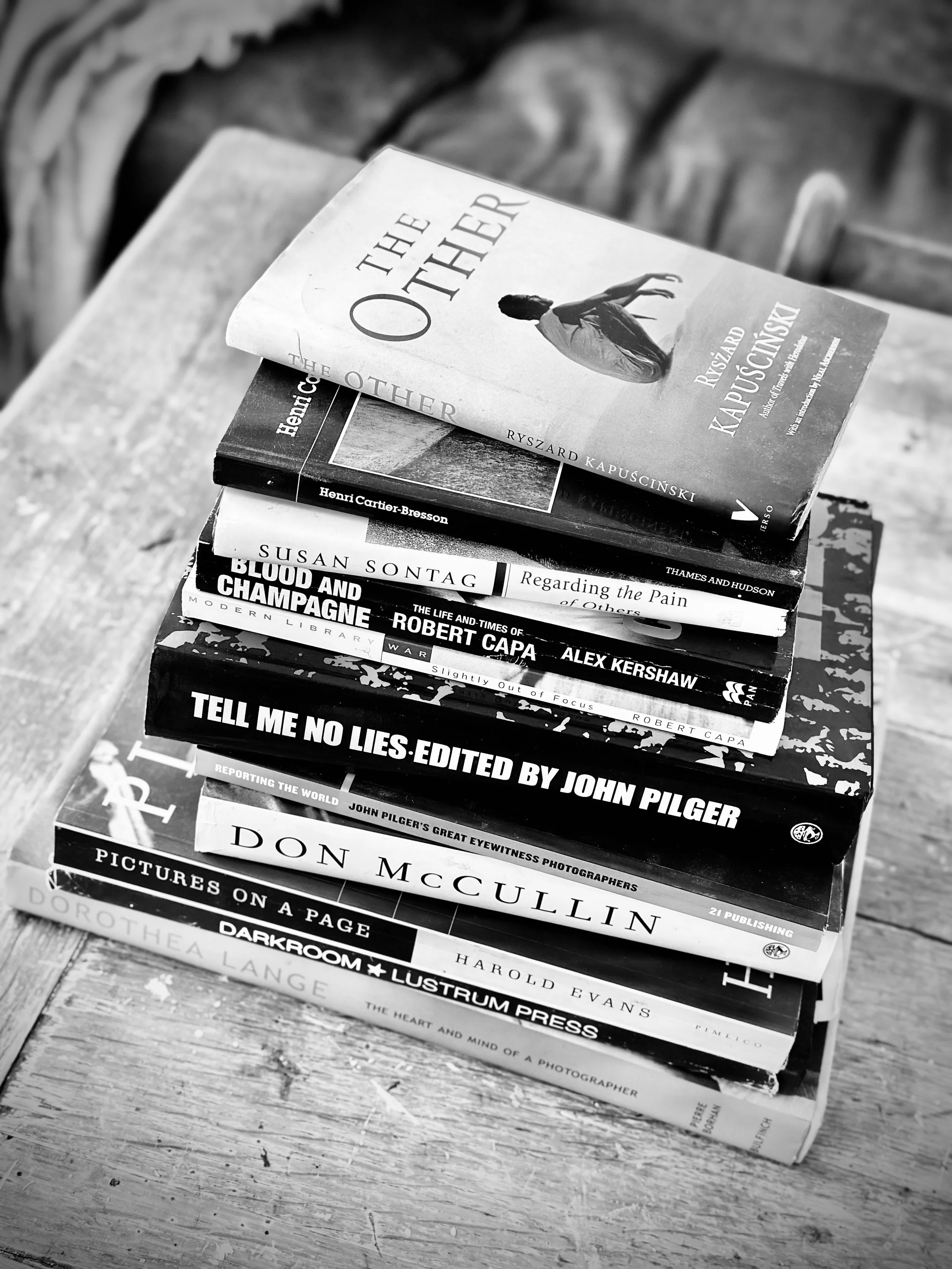
Book sources, for The Many Truths of Josef Batten
I. The Photograph
In 1964, Don McCullin photographed a group of young rebels in Stanleyville, in the Congo, in the moments before their execution. Whatever the circumstance, they were just teenage boys. Children. Sons.
I first saw the photograph as a student at West Surrey College of Art and Design, during the first Gulf War in 1990, and it has never left me.
It wasn't the image so much as the man behind the camera. What was he thinking in that moment? What allowed him to stay, to focus and press the shutter, when every instinct might have begged him to look away, or to take some form of preventative action? I found it deeply disturbing, and it raised questions I have been seeking answers for ever since.
Having listened to interviews with him over the years, I don't think Don McCullin has ever fully known the answers himself. I think the truth is more complicated than any answer he might have given. He has often described how ego was involved and how adrenaline played a part. What I struggle with is whether, at the moment of pressing the shutter, he believed the world needed to see it. The reflection seems to have come later, across decades of being asked, and I doubt much of it was available to him while he was standing there. Perhaps it was simply that photography was the only language he had, and the only way he knew how to be present in an unbearable moment. I doubt it was any single thing. I suspect it was all of them and more, tangled together and mostly unexamined, because there wasn't the time or space to examine them.
That tangle, the gap between what a person does and what they understand about why they're doing it, and how and why a photojournalist can bear to witness such a moment, became the burning questions that underpin everything I have written.
II. Word and Image
The Gulf War of 1990-91 drew me to the writers working alongside the photographers on the ground. I remember thinking that documentary photography without words and context felt somehow incomplete; that the image alone, however powerful, couldn't carry the full weight of what it showed.
At that time, Robert Fisk was reporting from Kuwait and Iraq with a clarity and moral seriousness that made the front page feel like it genuinely mattered, usually juxtaposed with photojournalism of equal seriousness. I also looked closely at the work of Ryszard Kapuscinski, a Polish journalist who spent a lifetime asking what a reporter owes to the people whose suffering they witness. And I was drawn to the more controversial ideas of the French philosopher Jean Baudrillard, who was examining what happens when an image becomes detached from the thing it depicts; when it begins to mean whatever we need it to mean, rather than what it actually shows.
My photography degree had also introduced me to the French thinker Roland Barthes, who argued that documentary photographs need words and context to be properly understood; that without a caption or a story, an image remains open to almost any interpretation. But Barthes also warned that words inevitably distort, select and mythologise. The photograph and its caption together produce a kind of managed truth, not a pure one. And whatever truth lies deepest in an image may be precisely what no caption can fully touch.
What all of these writers were really exploring, in different ways, was the idea of responsibility, perhaps more than truth itself. The photographer's responsibility to the person in the frame. The writer's responsibility to the photographer's image: to give it context and to refuse to let it be misread. And the reader's responsibility too: to look properly, to resist the easy interpretation, and to do the work that true understanding requires. None of this responsibility is automatic. It has to be chosen, by everyone in the chain, every time.
It is this idea: the ambiguity of truth, and the responsibility we each carry in how we make sense of what we see, that has driven everything in this novel.
III. The Heart of the Novel, and Where I Went Wrong
The Many Truths of Josef Batten is a novel about a war photographer who has spent thirty-five years inside that chain of responsibility, largely without examining it. For Josef, the camera is more than equipment, it is his armour. It lets him be present at things no one should have to be present at, without having to feel the full weight of what he is witnessing. He photographs because it's what he does, not because he's thought it through. Underneath the surface, in the parts of himself he has never had to look at, is an emotional landscape he doesn't know exists.
This is the heart of the novel. And it's also where my first draft struggled.
I spent twenty-one years trying to figure out how to tell this story, and in the end, I crudely told the reader all of it. I explained Josef and his armour, his unexamined motives, the gap between what he does and what he feels, and I handed the reader the analysis on a plate. What I didn't do was let them discover it for themselves, the way I had to discover it about Don McCullin; slowly, uncertainly, and with a great deal of confusion along the way.
What I needed was to understand McCullin through the gaps in what he was saying rather than the literal statements he was making; what a painter might call the negative space and the meaning that lives in what is left out rather than what is put in. Now that I'm in my sixties, I'm beginning to understand that it takes a lifetime to learn such things.
Slowly, what I am learning is the difference between telling and showing. This isn't a stylistic preference. For a novel like this one, it's the entire point. A reader who is told that Josef doesn't understand himself will simply agree and move on. A reader who is shown Josef's armour, who feels its weight without being told what it is, has to do some of the work themselves. They have to sit in the same uncertainty Josef sits in. That, I think, is the only way a story like this can do what it needs to do.
IV. Why It Matters Now
I started writing this novel in 2004. Before that, I'd spent years building Worth Digital, one of the first digital media agencies in the UK, set up in 1996 when most people had barely heard of the internet. It was an exciting time, and I helped build some of the early architecture of the digital world we now live in, long before anyone understood what it would become.
These days, I find myself deeply troubled by what it has become. The way algorithms can manipulate us is something I think about a great deal, probably more than is entirely healthy. An algorithm, to put it simply, is a set of instructions built into social media platforms and search engines that decides what you see, in what order, and how often. These systems are not neutral. They are designed, consciously and deliberately, to hold your attention, and they have discovered that anger, fear and outrage hold it most effectively. The people who own and control these systems are among the wealthiest individuals in human history, and their interests rarely align with ours.
The result is divisions in our societies unlike anything most of us have known in our lifetimes, and the steady erosion of empathy and the real, tactile, meaningful communities that human beings need in order to thrive.
We are living through a revolution in how truth is made, owned, and destroyed. The algorithms that govern what we see, what we feel, and what we believe are not neutral tools, they are instruments of power. Owning a newspaper once meant owning a measure of public opinion. The new media environment has gone further. It doesn't need the front page, it needs the feed. Through the social media feed and fast-paced short-form video content, it reshapes what people believe is real, often without their knowledge.
Today, in 2026, we live in a post-truth world in which photojournalism is effectively dead and real, in-depth investigative journalism is under sustained attack. Communities are being pulled apart by content designed to inflame rather than illuminate. Algorithms and artificial intelligence have reached a point where we can no longer be certain of what we are seeing and hearing.
I believe something different is urgently needed, and we need it now.
I believe that empathy and connection matter. Real, tactile, meaningful communities matter, for our children, and for theirs. This belief underpins everything in this book, and everything in this rewrite.
My hope, in reshaping this novel, is simple: in a world being divided by algorithms, manipulated by those who own the feed, and impoverished by content built to provoke rather than connect, there is a hungry audience for stories that ask something of them. Stories that trust their readers to find their own feelings, their own truths, their own understanding, rather than telling them what to believe and feel.
John Worth, June 2026