Exploring Truth: Duane Michals and the Things We Cannot See
"To photograph reality is to photograph nothing."
— Duane Michals (1932–2026)
"There are things not seen in this photograph."
These words are handwritten above a photograph taken by Duane Michals in 1977. The black and white image itself appears unremarkable: a bar, a cigarette machine, a few empty stools. The sort of place a photographer might walk past without a second glance. But then the text begins.
"My shirt was wet with perspiration. The beer tasted good, but I was still thirsty. Some drunk was talking to another drunk about Nixon. I watched a roach walk slowly along the edge of a bar stool. On the jukebox Glen Campbell began to sing about Southern Nights. I had to go to the men's room. A derelict was walking towards me to ask for money. It was time to leave."
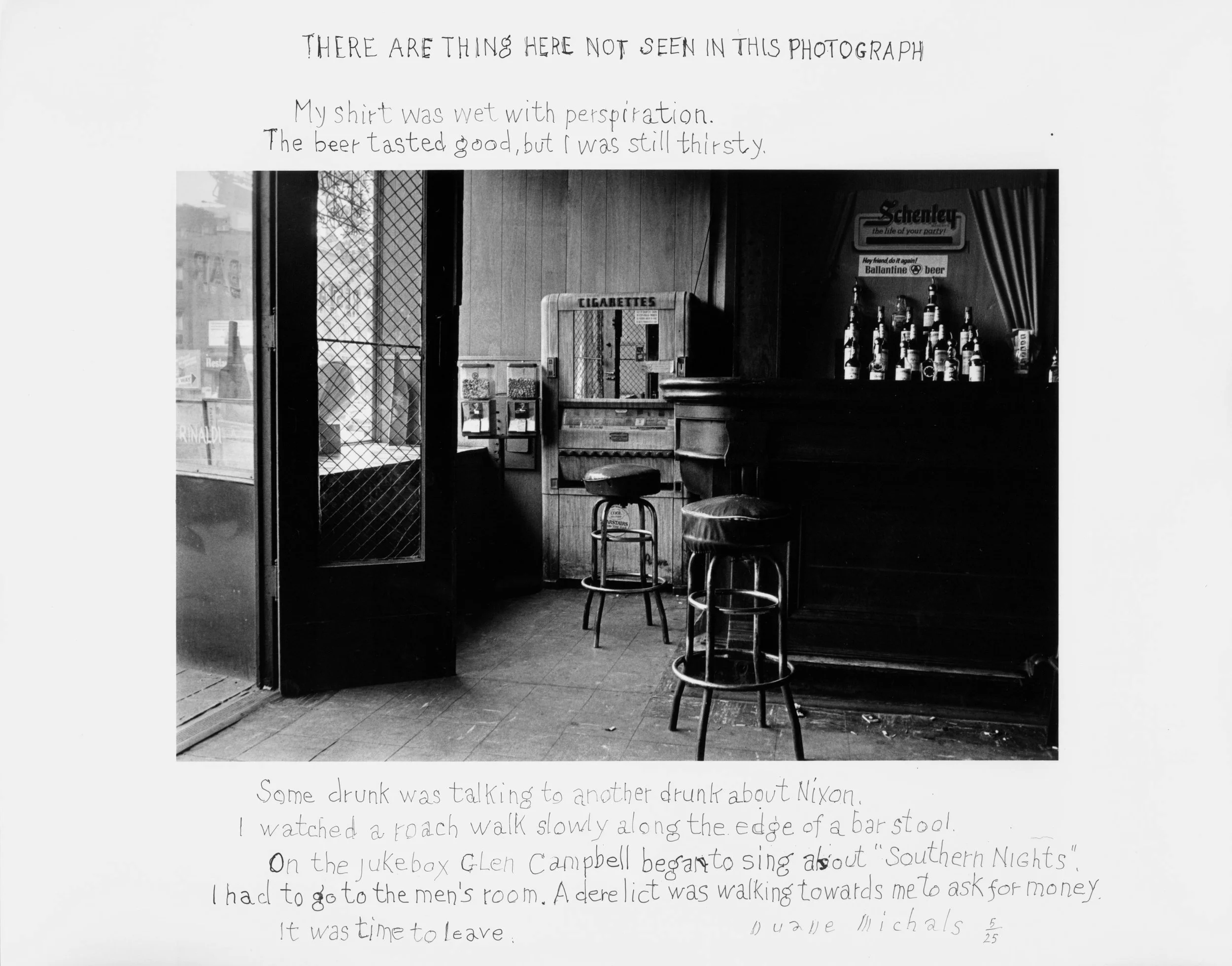
There Are Things Here Not Seen in this Photograph, Duane Michals, 1977
The photograph becomes something else entirely. It is no longer simply a record of a place. It introduces poetry and has the atmosphere of a Jim Jarmusch film — I almost expect Tom Waits to make an appearance. The image alone cannot tell us about the heat, the taste of the beer, the song on the jukebox, or the approaching stranger. Yet these details are precisely what make the moment real. The photograph gives us the surfaces but the hand written text supplies memory, sensation, movement and time. Together they generate something richer than either could achieve alone.
Duane Michals, who died in June 2026 at the age of ninety-four, spent much of his career exploring this gap between appearance and experience. While many photographers searched for ways to make photography appear more truthful, Michals was asking whether photography had ever been truthful in the first place.
His most famous statement remains one of the most provocative in the history of the medium:
"To photograph reality is to photograph nothing."
At first this sounds absurd. Photography records reality doesn’t it? It is just what cameras do. Isn’t it?
But Michals understood that a photograph records only a tiny fragment of realistic experience. This is because everything outside the frame disappears. The sounds, smells, memories, fears and histories that surround a moment are lost the instant the shutter is pressed. Reality is not a frozen instant. It includes memory, context, emotion, desire and interpretation. The camera simply mechanically records a surface, but human beings supply everything else.
His position was not always accepted or popular. For much of the twentieth century, photography enjoyed a special status as the witnessing medium. Photographs were treated as evidence. Henri Cartier-Bresson, perhaps the most influential photographer of the century, described his photography as capturing the "decisive moment", a fleeting instant when form, content and meaning align perfectly. Michals was pushing against that tradition. He was less interested in what happened than in what could not be seen happening. He understood that every photograph is a fragment pretending to be a whole.
What makes Michals particularly compelling is that he arrived at these ideas largely on his own. He never received a formal photographic education. He studied graphic design, not photography, and developed his approach through instinct and experimentation.
When I studied photography at West Surrey College of Art & Design in the late 1980s, the intellectual landscape surrounding the subject was shifting dramatically. Across art schools and universities, students were immersed in semiotics, the study of signs and meaning, and the ideas of philosophers such as Roland Barthes, Michel Foucault and Jacques Derrida. We were taught that photographs did not simply reflect reality; they produced meaning. Semiotics encouraged us to think about photographs as a form of language. Just as words acquire meaning through context and interpretation rather than possessing fixed meanings of their own, photographs were understood in the same way. For me, this was hard to grasp. At times I was confused, but there was something about these ideas that felt important. Looking back, if I’d had the understanding I have now, I would have suggested to our lecturers that they find ways to offer these concepts in less esoteric and more accessible formats.
Nonetheless, we were encouraged to ask who made an image, who published it, who consumed it and whose interests it served. And in this way the photograph became less a fact than a proposition, and certainties about reality gave way to ambiguity and, subsequently, objectivity gave way to interpretation.
What strikes me now is that Duane Michals had already covered much of this ground decades earlier. While academics were developing the language, he was making work that demonstrated its central insight.
This understanding runs throughout everything he made. His photographic sequences remain among his most original contributions to the medium. In works such as The Spirit Leaves the Body and Things Are Queer, meaning emerges not from individual photographs but from the spaces between them. The viewer must participate and connect the fragments, imagining what happens in the gaps. The sequence acknowledges what the single photograph conceals: that life unfolds through time and that understanding is something we construct rather than receive.
For generations, photographers insisted that pictures should speak for themselves, but Michals disagreed. His handwriting on his photographs feels like poetry or a confession. It seems he is saying the photograph cannot carry everything. Without it something remains unsaid so language must enter. Far from weakening the image, the text reveals its true nature. Every photograph needs a caption. Even when one is not provided, the viewer invents one. We are storytelling creatures. We encounter an image and immediately begin constructing narratives around it.
This is where photography becomes fascinating and dangerous. The image and the caption are often treated as if they are the same thing, but they are most certainly not. The photograph shows us something, but it is the caption that tells us what we are meant to think it means. Between those two things lies a territory filled with ambiguity — and often in a sinister way, with power.
This is what lies at the heart of my novel The Many Truths of Josef Batten. Josef is a war photographer haunted by the uneasy relationship between images and truth. One of the novel's recurring subjects is a photograph connected to the My Lai massacre of 1968. Josef discovers in later life that a photograph and its caption can contain entirely different truths. What the photographer witnessed, what the editor published, what history remembers and what the viewer believes may all be different things. The image remains the same. The meaning changes entirely.
Robert Frank understood this too. Having helped create one of the defining visual mythologies of America through The Americans, he later turned towards text, collage and personal narrative. The photograph alone was no longer enough. Like Michals, he recognised that a photograph without context is never objective. It is an imaginative act. A fragment, or perhaps an invitation.
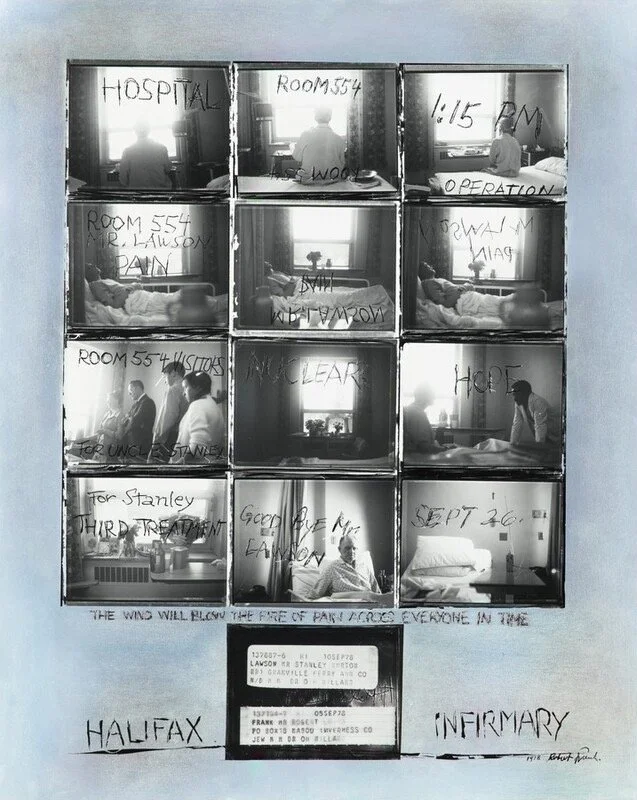
Halifax Infirmary, Robert Frank, 1978
Perhaps what Duane Michals understood better than almost anyone is that the frame is almost always a lie of omission, not because photographers are dishonest, but because reality itself is too large, and way too complicated and contradictory to fit inside a rectangle. Every photograph excludes far more than it contains.
The question is not whether a photograph tells the whole truth. It never does. The more demanding question is what truths remain waiting beyond its edges, and what happens when we finally go looking for them.
John Worth is a painter, photographer and writer based in Lewes, East Sussex. His novel The Many Truths of Josef Batten will be published in late 2026.